Crate Training a Puppy When You Work Full Days
If you are wondering how to crate train a puppy when you work full time, you are in good company. Most crate training advice quietly assumes someone is home all day to let the puppy out every couple of hours. For a family with jobs, school runs and a commute, that assumption makes the whole thing feel like a failure before it starts.
It is not one. A puppy can be raised well by a household that is away on weekdays, as long as the day has a plan built into it. This guide covers what a puppy can manage at each age, how to make the crate a place your puppy likes, and who can cover the middle of the day.
Why the full-day worry is normal (and what your puppy actually needs)
Feeling guilty about shutting a small, wriggly puppy in a crate means you care about how the puppy feels. That instinct is useful. It will push you to arrange the midday help your puppy needs.
A young puppy needs four things from a day: regular chances to go to the bathroom, enough sleep, some real play and attention, and a safe place to rest when no one can watch. The crate covers the last two when it is set up well. It cannot cover the first one for eight or nine hours, and no crate training method changes that.
So the honest starting point is that a young puppy should not spend a full workday in a crate with no break. Someone needs to come at midday, or you need to arrange your first weeks so the puppy is never alone that long. Once you accept that, the rest becomes a scheduling problem, and scheduling problems can be solved.
How long a puppy can really stay in a crate at each age
A common rule of thumb is that a puppy can wait roughly one hour for every month of age, plus one. Treat it as a ceiling, not a target. Some puppies need to go out sooner, especially after eating, drinking, playing or waking up.
Here is what that looks like in practice during the day:
- 8 to 10 weeks: about 1 to 2 hours at a stretch
- 3 months: about 2 to 3 hours
- 4 months: about 3 to 4 hours
- 5 months: about 4 to 5 hours
- 6 months and older: about 5 to 6 hours at most for most puppies, and many do better with less
Small breeds often need more frequent breaks than larger ones, and individual puppies vary. Your vet can tell you what is reasonable for your puppy’s breed and health.
Look at those numbers next to a typical workday of 8 to 10 hours away, including the commute. Even a 6-month-old is at the edge of what is comfortable. A midday visit is part of the plan for the first several months.
Overnight is different, because a sleeping puppy can usually go longer. A very young puppy may still need one late-night trip outside, and that is normal.
Make the crate a happy place before your first workday
A puppy who loves the crate will settle for a nap while you are gone. A puppy who has only ever been shut in it when the family leaves will protest. So build positive feelings first, ideally over a few days before your first full day away.
Start with the setup. Choose a crate big enough for the puppy to stand, turn around and lie down, but not much bigger. Many crates come with a divider so you can enlarge the space as the puppy grows. Put a washable mat or blanket inside and place the crate somewhere the family spends time, so the puppy can hear you nearby.
Then build the habit in small steps:
- Let the puppy explore with the door open. Toss a few treats inside and let the puppy walk in and out freely.
- Feed meals in the crate. Put the bowl at the back, and leave the door open at first. Once the puppy eats comfortably, close the door for the length of the meal and open it before the puppy gets upset.
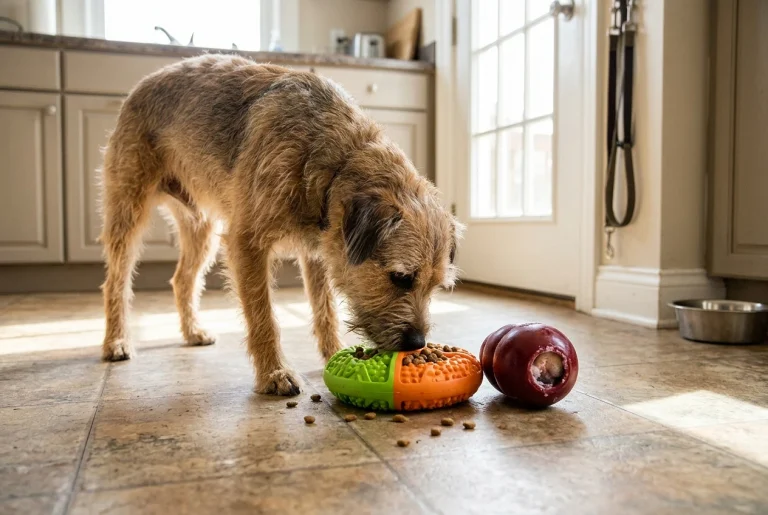
- Offer a chew or stuffed toy inside. A puppy-safe chew, or a hollow toy stuffed with a little of the puppy’s regular food, gives the crate a pleasant job.
- Close the door for short periods. Sit nearby for a minute or two, then let the puppy out. Add time slowly.
- Step out of the room. Leave for a few seconds, return, and gradually stretch it to minutes.
Open the door when the puppy is calm, not while the puppy is fussing. Otherwise the puppy learns that fussing opens the door. If the puppy is whining, wait for a brief pause, then open it.
The crate should never be a punishment. Do not send the puppy there when you are frustrated about an accident or a chewed shoe.
A sample weekday schedule for a puppy and a working family
Every household differs, so adjust the times to your own hours. This example assumes a puppy around 3 to 4 months old, a family out of the house from about 8:00 to 5:30, and someone coming at midday.
- 6:30 a.m.: Straight outside to the bathroom spot. Praise and a small treat when the puppy goes.
- 6:45 a.m.: Breakfast, then another trip outside.
- 7:00 a.m.: Play and a short training session, such as sit, or coming when called.
- 7:40 a.m.: One more bathroom trip, then the puppy goes into the crate with a chew or stuffed toy. You leave around 8:00.
- Around 11:30 a.m. to noon: Your midday helper takes the puppy out, offers water and lunch if the puppy eats one, plays for a bit, and returns the puppy to the crate or a puppy-safe play area.
- Mid-afternoon: Depending on the puppy’s age, a second break may be needed if you will not be home until after 5.
- 5:30 p.m.: Straight outside on arrival. Greet the puppy calmly, then give a real play session.
- 6:00 p.m.: Dinner, followed by a bathroom trip.
- Evening: Family time, training, a walk if the vet has cleared the puppy for them, and a few crate naps even while you are home. This keeps the crate from meaning only “everyone left.”
- 10:30 or 11:00 p.m.: Last bathroom trip, then bed in the crate near your room.
A tired puppy sleeps more easily in the crate, so a good play session before you leave helps. Keep the morning routine calm, though. A puppy wound up like a spring will have a harder time settling down.
Your own feeding times and amounts depend on the puppy’s food and your vet’s advice, so use this only as a pattern for the day.
Who can cover the midday break: family, neighbors, walkers, or daycare
The midday visit is the piece that makes the whole plan work, so it is worth sorting out before the puppy comes home. The helper only needs to do a few things: let the puppy out, praise the puppy for going, give water, and spend ten or twenty minutes playing.
Some options to consider:
- A family member with flexible hours. A partner who works from home, a teen home early from school, or a grandparent nearby can take on this role. Make it a clear routine, so it does not depend on who remembers.
- A neighbor you trust. A retired neighbor or someone who works from home may be glad to help, perhaps in exchange for a thank-you gift or a swap of favors.
- A dog walker or pet sitter. Many offer short drop-in visits that fit this need exactly. Ask whether they are insured, whether they know how to handle young puppies, and whether they can follow your routine. Meet them with the puppy before the first booking.
- Puppy daycare. Some families use daycare a few days a week, especially while the puppy is between 4 and 6 months old. Ask about vaccination requirements, how they separate puppies by age and size, and how much rest time the puppies get. A puppy who has played all day may be worn out, which is fine.
- Your own schedule. If you work near home, a lunch-hour visit may be possible. Some people also use the first few weeks of puppy life to take time off, or shift hours with an employer’s agreement.
It helps to line up a backup person too. Someone will get sick or stuck in traffic eventually, and a puppy that is left too long may have an accident, which sets back house training.
Setting up the crate and play space while you’re out
For the stretch when you are gone, think about what the puppy will do for the whole time: sleep, chew, and wake up needing something to do. The setup should make all of that easy.
Place the crate in a quiet, comfortable spot, away from direct sunlight, drafts and heating vents. The room should be a normal indoor temperature, and the puppy should have air flow through the crate. Remove collars, tags or anything with a strap that could snag on the crate bars.
Inside the crate, offer a soft bed that the puppy will not shred, and one or two safe chews or a stuffed toy. Supervise a new chew in your presence first, so you know how your puppy handles it. Take away anything that gets chewed into small pieces. Water is also worth thinking about. Many people leave a small, spill-resistant water source for longer absences, though that depends on the puppy’s age and house-training stage, so ask your vet.
If your puppy will be out longer than the crate limit, a playpen can be a better choice than a crate alone. A pen with a sleeping area, a toilet area with puppy pads or turf, and toys gives the puppy room to move. This is also a good setup for the youngest puppies, who cannot wait long between breaks. Some families begin with a pen while the puppy is tiny, and move to the crate for naps as the puppy grows.
Before you leave each morning, do a quick check: has the puppy been outside, is the space safe, is there a chew, and is the door latched? Keep your departures low-key. A long, emotional goodbye can make the puppy more anxious.
Signs the crate plan isn’t working yet, and what to adjust
Every puppy needs time to adapt, and some trouble in the first weeks is ordinary. A few signs call for a change in the plan:
- Accidents in the crate. The puppy is probably being asked to wait too long, or the crate is too large and has room for a corner to use as a toilet. Shorten the gap, add a visit, or reduce the crate size with a divider.
- Constant barking or whining. Some fussing at the start is common, but non-stop crying for long periods suggests the puppy is not ready for that length of time. Go back a step. Practice shorter absences, and check that the puppy has had enough exercise and a bathroom break before you leave.
- Refusing treats or food while alone. A puppy that will not eat even a favorite treat when you are out may be stressed.
- Drooling, panting, or scratching hard at the door. These can be signs of distress rather than ordinary protest. The puppy may also hurt a paw or teeth.
- Damaged bedding or crate parts. A puppy who chews the crate itself may be bored, anxious, or both.
When something is off, slow down rather than pushing through. Return to the short, easy steps. Add a midday visit or a second one. Look at the puppy’s exercise and play before you go.
If the puppy shows real panic when left, or if the problem does not improve in a couple of weeks, speak with your vet or a qualified trainer. Separation distress is different from ordinary crate protest, and it responds best to early help.
Crate gear worth considering for working households
You do not need much equipment, but a few items make weekdays easier:
- A crate with a divider panel. It grows with the puppy, so you buy one crate instead of several.
- A washable crate mat or bed. Accidents will happen, and one you can toss in the wash saves effort. Pick one that the puppy is not likely to chew apart.
- Puppy-safe chews and stuffable toys. These give the puppy something to do when you leave. Choose sizes that suit your puppy and replace them when they wear down.
- A playpen. It gives a bigger space for the youngest puppies or longer days.
- A crate cover. Some puppies settle better when part of the crate is shaded. Leave enough ventilation.
- Enzyme cleaner. It removes the scent of accidents, which helps discourage repeat spots.
- A pet camera. It lets you see how the puppy settles, which can ease your mind and help you spot problems with the plan.
Start with the basics and add items only when you see a need.
Your next step
You now have what you need to build a crate routine around a full workday: realistic time limits for your puppy’s age, a happy-crate routine, a midday plan, and a way to spot problems early. If you want a place to start with gear, see our short list of crate and puppy-safe chew recommendations. DoggyPosts may earn a commission on products bought through those links, at no extra cost to you.
Once the crate routine is running, the next everyday question is usually food. Our guide on how to choose your first dog food without overthinking it is a good next read for new dog parents.